


The Cradle of Civilization
- Feb 17, 2019
- 4 min read

We were fortunate recently to attend a Mercers' Lecture given by the BBC Security Correspondent, Frank Gardner, OBE. A fluent Arabist with a degree in Arabic and Islamic studies, Frank spent nine years as an investment banker before switching to journalism and becoming the BBC’s Middle East correspondent based in Cairo. In 2004, while reporting in Saudi Arabia, he was shot and left partly paralysed in an attack by al-Qaeda terrorists and is now dependent on a wheelchair.
Frank is passionate about all things Arabic and gave us a fascinating overview of his travels in that region, as well as his thoughts on the current situation in the Middle East.
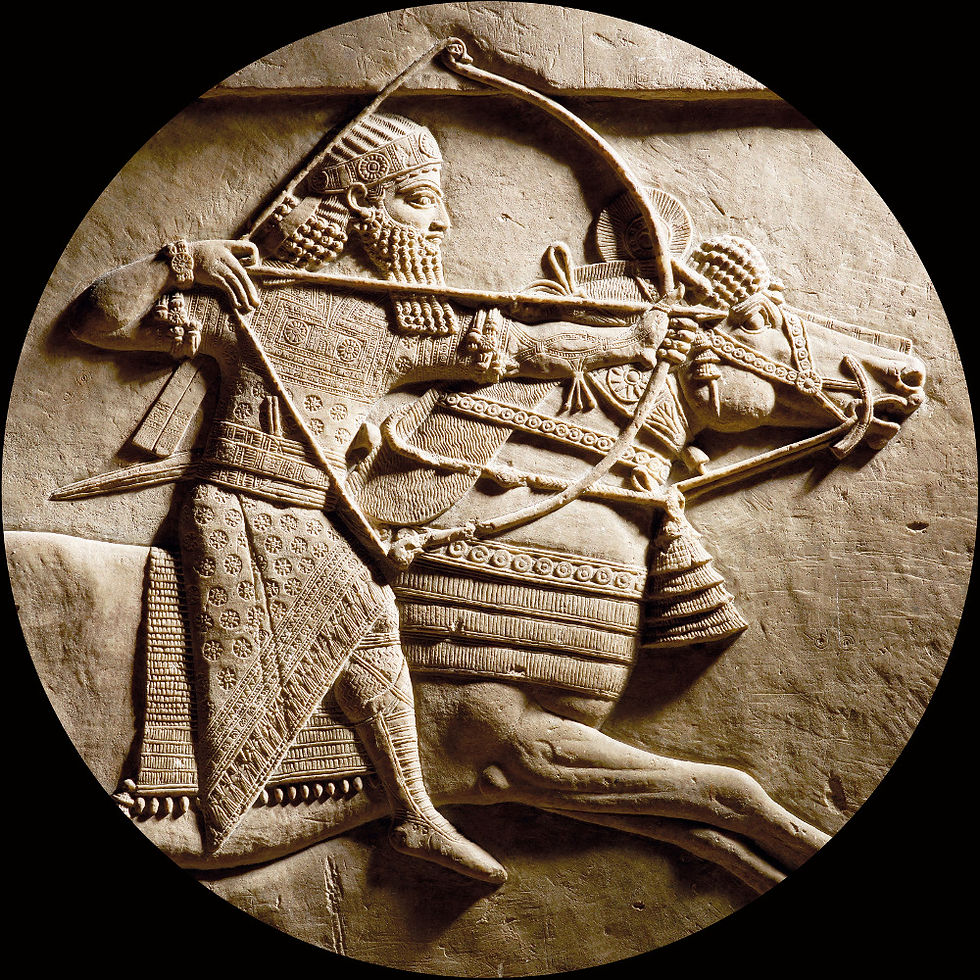
It was timely, therefore, that we had booked tickets for the British Museum exhibition,
I am Ashurbanipal, King of Assyria, King of the World. He was described as:
Warrior. Scholar. Empire builder. King slayer. Lion hunter. Librarian. (more about the library below!)
Here is a video review of the exhibition:
This is quite an awe-inspiring exhibition and, given what is happening in the region today and the destruction of many cultural heritage sites, very moving.
The history of the ancient Near East (the term commonly used for the area until World War I) was shaped by the rise of Assyria in present-day Iraq. When Ashurbanipal came to power in 669 BC the empire was at its height, stretching from the eastern Mediterranean to western Iran. The remains of his capital Nineveh, the greatest city of its day, are now in the city of Mosul in Iraq. The city was transformed by Ashurbanipal's grandfather, Sennacherib which immediately brought to mind Lord Byron's famous poem I learnt in school. The poem relates to the Biblical account of Sennacherib's attempted siege of Jerusalem.
The Destruction of Sennacherib
BY LORD BYRON (GEORGE GORDON)
The Assyrian came down like the wolf on the fold,
And his cohorts were gleaming in purple and gold;
And the sheen of their spears was like stars on the sea,
When the blue wave rolls nightly on deep Galilee.
Like the leaves of the forest when Summer is green,
That host with their banners at sunset were seen:
Like the leaves of the forest when Autumn hath blown,
That host on the morrow lay withered and strown.
For the Angel of Death spread his wings on the blast,
And breathed in the face of the foe as he passed;
And the eyes of the sleepers waxed deadly and chill,
And their hearts but once heaved, and for ever grew still!
And there lay the steed with his nostril all wide,
But through it there rolled not the breath of his pride;
And the foam of his gasping lay white on the turf,
And cold as the spray of the rock-beating surf.
And there lay the rider distorted and pale,
With the dew on his brow, and the rust on his mail:
And the tents were all silent, the banners alone,
The lances unlifted, the trumpet unblown.
And the widows of Ashur are loud in their wail,
And the idols are broke in the temple of Baal;
And the might of the Gentile, unsmote by the sword,
Hath melted like snow in the glance of the Lord!

The size and splendour of the city at Nineveh astonished the Near Eastern world. Sennacherib had built an immense canal network, bringing water to the city over a great distance using canals and aqueducts, remains of which can still be found in Iraq today.
As future ruler of Assyria, Ashurbanipal was expected to excel in all aspects of kingship. However he claimed that, unlike earlier kings, he had mastered the scribal arts, could solve complex mathematical problems and debate with expert scholars.
In 1850, the English explorer, Austen Henry Layard, discovered 'The Library of Ashurbanipal', over 30,000 tablets and fragments inscribed with cuneiform script, a type of writing used in Mesopotamia (ancient Iraq). Until then almost everything we knew about ancient Assyria came from stories in the Bible or classical historians. With the discovery of the Library, thousands of cuneiform texts were recovered, telling the Assyrians’ story in their own words (British Museum blog). It is accepted as one of the most important archaeological discoveries ever made. Nineveh and it's library were destroyed by fire around 612 BC. But while paper books are destroyed by fire, the clay tablets were in most cases baked harder, making them among the best preserved documents from thousands of years of Mesopotamian history.


Ashurbanipal’s father wanted the young prince to be
educated because this would give him direct access to the expertise he relied on to run the empire. Assyrian scholarship was focused on understanding the will of the gods, so his Library focused on texts that interpreted omens from the gods. However, Ashurbanipal had an interest in literary books as well. Ashurbanipal still kept tablets he had written during his training, presumably for sentimental reasons. Many of the tablets in his collection bear a ‘library stamp’ of sorts—stating that they belong to his palace.

One of the most famous works of Mesopotamian literature is The Epic of Gilgamesh. Its elegant prose describes the adventures of the hero as he confronts the deepest human emotions, from friendship and love to mourning and death. Each chapter was written on a separate tablet. Ashurbanipal had several sets of these tablets. You can still buy a Penguin classic today.
Researchers from around the world have worked tirelessly to read the fragments and identify which texts they came from. Although the exhibition finishes on 24th February, a selection of the library's tablets are on permanent display in Room 55 of the British Museum. The Museum is currently digitising the entire Library of Ashurbanipal and researching its origins. There is more to be discovered!
Comments